





1. Background: Biological Impact of Light in WELL
The WELL Building Standard (WELL v2), developed by the International WELL Building Institute (IWBI) and affiliated with Delos, incorporates multiple light-related features that target both visual and non-visual effects of light.
Relevant WELL concepts and features include
- FEATURE L01 – Light Exposure
- Overview: Requires a minimum level of light in regularly occupied spaces via daylight and/or electric light.
- Scientific background:
- Visible light spans roughly 380–750 nm, detectable by photoreceptors in the eye.
- All visible light, not just daylight, influences human biology and physiology.
- In spaces without adequate daylight, electric lighting may be used to deliver the required light exposure during the day.
- Novel metrics, such as melanopic equivalent lux, focus on how the photoreceptors primarily responsible for circadian regulation (intrinsically photosensitive retinal ganglion cells, ipRGCs) respond to light.
- Traditional metrics (e.g. photopic lux) are weighted to rods and cones (vision), whereas melanopic metrics extend assessment to non-visual effects (e.g. hormone levels, sleep quality, mood, cognition).
- Further research is still needed to reach a consensus on a standardised single unit for non-visual responses to light.
- FEATURE L03 – (Circadian-related requirement)
Calculating numeric EML targets for scoring:- 1 point:
- At least 150 EML [136 melanopic equivalent daylight D65],
OR - At least 120 EML [109 melanopic equivalent daylight D65] from electric light plus at least 2 points in Feature L05: Enhanced Daylight Access.
- At least 150 EML [136 melanopic equivalent daylight D65],
- 3 points:
- At least 240 EML [218 melanopic equivalent daylight D65],
OR - At least 180 EML [163 melanopic equivalent daylight D65] from electric light plus at least 2 points in Feature L05.
- At least 240 EML [218 melanopic equivalent daylight D65],
- 1 point:
These targets show how WELL uses EML as a performance metricfor the biological (circadian) impact of light.
2. Definitions: Equivalent Melanopic Lux (EML) & Melanopic Ratio (MR)
From WELL-related material:
- Equivalent Melanopic Lux (EML)
- A metric that incorporates both:
- The quantity of light (illuminance), and
- The spectral composition of that light.
- It is calculated on a vertical plane, 1.2 m above the floor, in the direction the viewer is facing.
- Intended to approximate how strongly a given light exposure stimulates the ipRGCs (and other photoreceptors) relative to a reference “melanopic” response.
- A metric that incorporates both:
- Melanopic Ratio (MR)
- A factor that links visual lux to melanopic response for a given luminaire spectrum.
- It reflects the α-opic response for each of the five key photoreceptors in the human eye:
- Three cones (L, M, S),
- Rods,
- Intrinsically photosensitive retinal ganglion cells (ipRGCs).
- The spectrum of the light source (i.e. its spectral power distribution) determines how much energy is emitted at different wavelengths, and this is mapped to the sensitivity curves of each photoreceptor.
- Spectral energy is typically measured every 5 nm from 380 nm to 780 nm.
- These spectral data are then entered into an MR calculator to determine the Melanopic Ratio for the luminaire’s correlated colour temperature (CCT).
3. Calculation Method: EML and MR
Below is a clear step-by-step process for computingEquivalent Melanopic Lux.
3.1 Core Formula
EML = Lx × MR
Where:
- Lx = Visual lux Ev (vertical illuminance) at 1.2 m above floor, in the direction of view.
- MR = Melanopic Ratio derived from the luminaire spectral test report (via α‑opic calculations for the five photoreceptor types).
3.2 Measurement Geometry
- EML is not calculated on the workplane horizontally; it is based on vertical illuminance at eye height:
- Plane: Vertical
- Height: 1.2 m above floor
- Direction: In the direction the viewer is facing
- For accurate assessment:
- A floor layout that includes desk position and orientation should be provided so that eye-facing directions and viewing positions are modelled correctly.
3.3 Stepwise Procedure
- Step 1 – Determine vertical illuminance
- Calculate or measure Ev (vertical illuminance) at 1.2 m in the direction of view.
- Example given:
- Horizontal illuminance: Eh = 330Lx
- Vertical illuminance: Ev = 110 Lx
- Step 2 – Determine luminaire CCT and MR
- Identify the CCT of the luminaire from the spectral test report.
- For tuneable white systems, pick the highest CCT used for compliance checks – the example uses 6500 K.
- Obtain the Melanopic Ratio from the luminaire’s spectral data (via MR calculator).
- Example spectral-based MR values (for a specific luminaire type):
- Identify the CCT of the luminaire from the spectral test report.
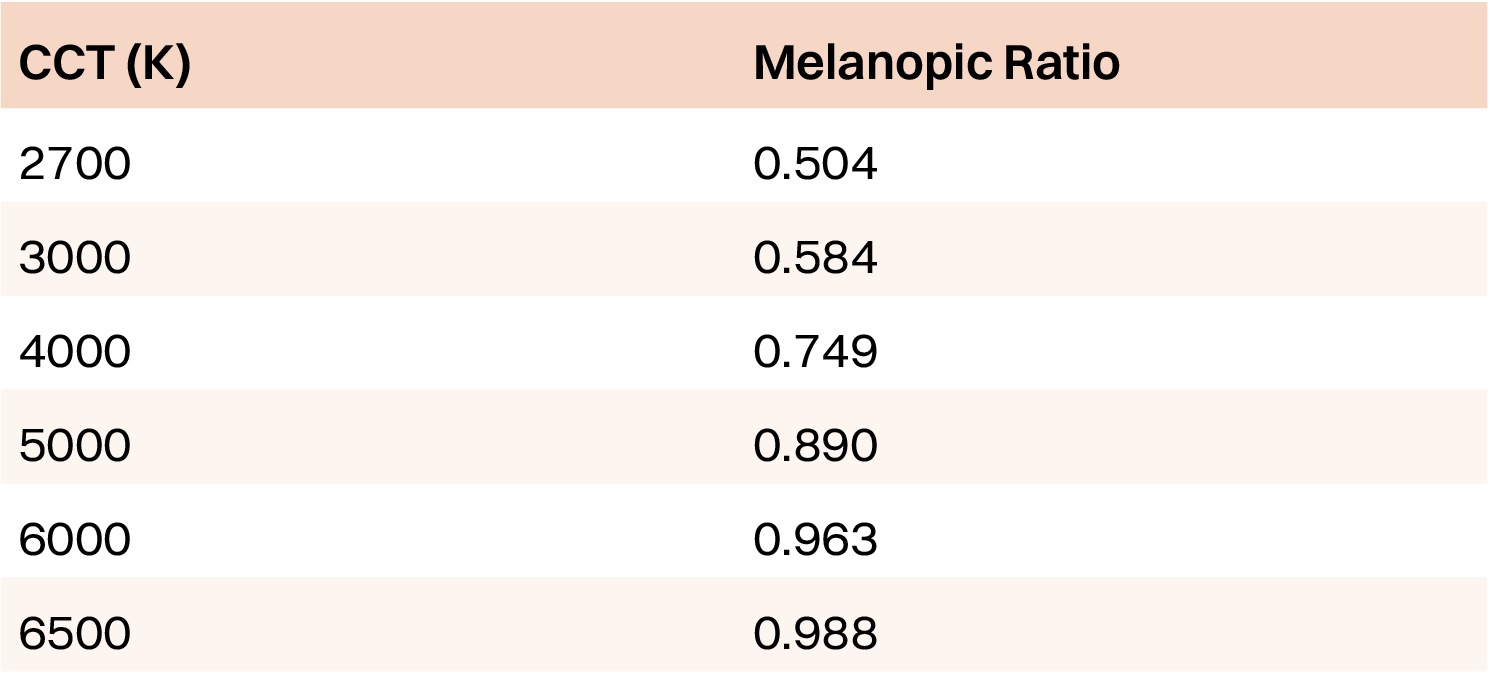
- Step 3 – Calculate EML
- Apply the formula: EML = Ev x MR
- Example 1 – 6500 K tuneable system
- Ev = 110 Lx
- MR (6500 K) = 0.988
- Calculation (using the example numbers given):
- EML = 110 x 0.988 ≈ 110
- Example 2 – 4000 K fixed CCT installation
- Ev = 110 Lx
- MR (4000 K) = 0.749
- Calculation:
- EML = 110 x 0.749 ≈ 82
The key takeaway is that identical visual illuminance can produce different EML values depending on the spectral content / CCT of the luminaire.
4. Relationship to WELL Points and Daylight
These EML values link directly to WELL performance thresholds:
- Feature L03 thresholds:
- 1 point:
- At least 150 EML,
OR - At least 120 EML from electric lighting plus sufficient daylight (defined as achieving at least 2 points in Feature L05 – Enhanced Daylight Access).
- At least 150 EML,
- 3 points:
- At least 240 EML,
OR - At least 180 EML from electric lighting plus 2 points in Feature L05.
- At least 240 EML,
- 1 point:
Additional notes from the material:
- Daylight contribution:
- EML can be calculated with contributing daylight, but:
- This is described as outside the scope of most lighting design services at present.
- Many practitioners therefore initially evaluate electric light-only EML, then use WELL daylight features (e.g. Feature L05) to complement the overall light exposure strategy.
- EML can be calculated with contributing daylight, but:
5. Context within the WELL Light Concept
Beyond EML itself, other WELL lighting features and contextual information that frame how melanopic metrics fit into the broader standard:
- WELL Concept: LIGHT
- Intent: Among other aims, to minimise visual discomfort (e.g. glare) and create visually comfortable lighting environments while also supporting biological needs (e.g. circadian rhythms).
- FEATURE L04 – Glare Control Optimisation (max 3 points)
- Intent: Minimise visual discomfort caused by glare from daylight and electric light through appropriate calculation, luminaire selection, and shading strategies.
- Verified by performance testing.
- FEATURE L06 / L07 – Visual Balance / Visual Balance Optimisation
- Intent: Create lighting environments that enhance visual comfort and manage brightness.
- Requirements include:
- Avoiding luminance ratios where a main room is more than 10× brighter or dimmer than an adjacent ancillary space.
- Avoiding adjacent surfaces with luminance differences greater than 3 × times greater or lesser luminance than an adjacent surface.
- These features ensure that while light is increased for biological needs (high EML), visual comfort and luminance balance are not compromised.
- Verified by an architect.
6. Practical Design Implications
Drawing together the above points from the provided materials:
- Designers must account for both quantity and spectrum of light.
- Traditional photopic lux alone is insufficient for WELL’s biological light requirements; the Melanopic Ratio is required to convert visual lux into Equivalent Melanopic Lux.
- Measurement / modelling at the eye is crucial.
- EML is calculated at 1.2 m height on a vertical plane, in the direction of gaze, which often differs substantially from horizontal workplane illuminance.
- Spectral data are essential.
- Achieving WELL targets requires:
- Spectral power distribution (SPD) of luminaires (380–780 nm, ideally at 5 nm intervals),
- Use of an MR calculator to derive the melanopic ratio for each CCT.
- Achieving WELL targets requires:
- CCT selection significantly affects EML.
- Higher CCT / more “daylight-like” spectra generally show higher MR values, thus providing higher EML for the same visual illuminance.
- Combination of electric lighting and daylight.
- WELL explicitly allows achieving certain EML targets through electric lighting plus daylight, linking EML-based features (e.g. L03) with daylight features like L05.
Summary
From the WELL v2 extracts, the Equivalent Melanopic Lux(EML) and Melanopic Ratio (MR) are central to how WELL quantifies the biological (non-visual) impact of light. EML provides a way to translate conventional illuminance values into a metric weighted by the melanopic response, with MR acting as the spectral conversion factor. WELL uses EML thresholds in its Light Concept scoring (particularly in Feature L03 and in combination with daylight Feature L05) to ensure that occupants receive adequate circadian-effective light, while other features (L04, L06/L07) maintain visual comfort and control glare and luminance balance.

Related content

Why Circadian Lighting Metrics Matter for Modern Commercial Spaces
Lorem ipsum dolor sit amet, consectetur adipiscing elit. Suspendisse varius enim in eros elementum tristique. Duis cursus, mi quis viverra ornare, eros dolor interdum nulla, ut commodo diam libero vitae erat. Aenean faucibus nibh et justo cursus id rutrum lorem imperdiet. Nunc ut sem vitae risus tristique posuere.
Technical Bulletin: Cyanosis Observation Index (COI) and AS/NZS 1680.2.5:2018
Lorem ipsum dolor sit amet, consectetur adipiscing elit. Suspendisse varius enim in eros elementum tristique. Duis cursus, mi quis viverra ornare, eros dolor interdum nulla, ut commodo diam libero vitae erat. Aenean faucibus nibh et justo cursus id rutrum lorem imperdiet. Nunc ut sem vitae risus tristique posuere.
Novon Wins Company Sustainability Award
Lorem ipsum dolor sit amet, consectetur adipiscing elit. Suspendisse varius enim in eros elementum tristique. Duis cursus, mi quis viverra ornare, eros dolor interdum nulla, ut commodo diam libero vitae erat. Aenean faucibus nibh et justo cursus id rutrum lorem imperdiet. Nunc ut sem vitae risus tristique posuere.