





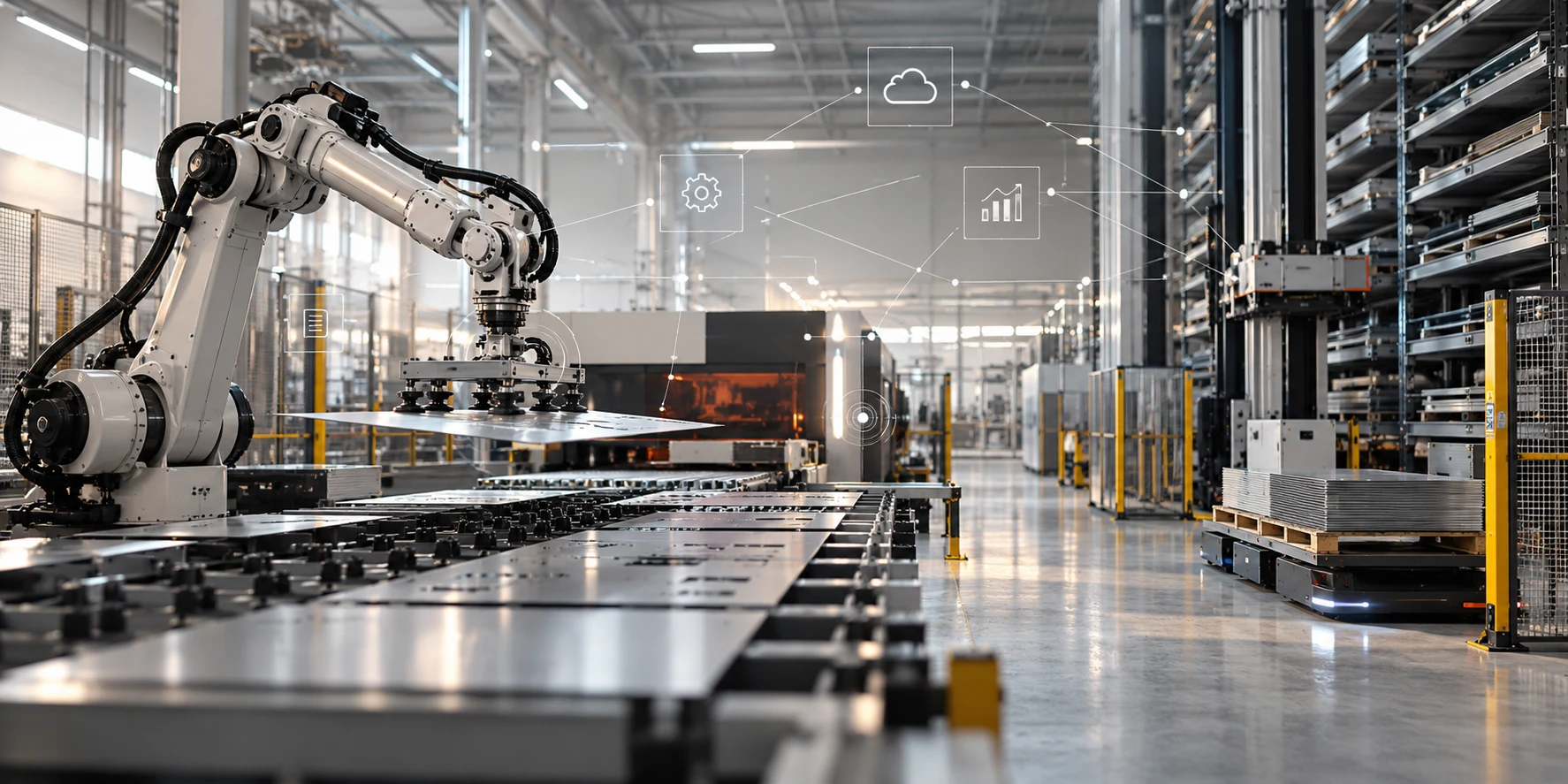
Manufacturing has always evolved alongside technology. From steam power and electrification to robotics and digital systems, each major industrial shift has changed not only how products are made, but what manufacturers are capable of achieving.
Industry 4.0 represents the latest stage of that evolution.
The term is often associated with robotics, automation, artificial intelligence and smart factories. But Industry 4.0 is not simply a more advanced version of automation. Its defining characteristic is connection.
Machines communicate with systems. Data moves between processes. Production stages respond to one another. Materials can be identified, retrieved and processed with limited manual intervention. Information generated during manufacturing can influence what happens next.
In other words, individual technologies begin operating as part of a connected manufacturing environment.
The Australian Government describes Industry 4.0 technologies as connecting the physical world with the digital world through technologies such as artificial intelligence, automation and cloud computing. The European Parliament similarly describes the transformation around sensors, connected networks, intelligent machines and integrated data flows throughout manufacturing.
But before getting to Industry 4.0, it is worth understanding the revolutions that came before it.
Before 4.0, how did manufacturing get here?
The development of modern manufacturing is commonly described through four industrial revolutions.
The boundaries between each period are not exact, and technological change rarely happens at a single point in time. But the framework provides a useful way of understanding how production has progressed from mechanical power to connected, intelligent manufacturing systems.

Industry 1.0 — Mechanisation
The First Industrial Revolution began in the late eighteenth century, when steam and water power increasingly replaced human and animal labour.
Mechanised equipment transformed industries such as textiles, mining and metal production. Tasks that had previously relied heavily on manual effort could now be performed by machines at far greater scale.
This marked a fundamental change in production. Manufacturing began shifting away from individual craft-based methods towards mechanised factories capable of producing larger quantities with greater consistency.
Industry 2.0 — Electrification and mass production
The next major transformation came with electricity.
Electric motors gave factories greater flexibility in how machinery could be arranged and operated, while assembly-line production allowed complex products to be divided into a sequence of repeatable tasks. This laid the foundation for modern mass production.
One of the best-known examples came from Ford Motor Company. In 1913, Ford began using the moving assembly line at its Highland Park plant, allowing vehicles to move progressively through individual production stages rather than remaining stationary while workers moved around them. Ford records that the process dramatically increased production and became a defining example of large-scale industrial manufacturing.
The principles established during this period remain fundamental to manufacturing today: repeatability, standardisation, flow and scale.
Industry 3.0 — Automation and computing
The third industrial revolution emerged through electronics, computing and increasingly sophisticated automation.
Computer-controlled machinery, programmable logic controllers and industrial robotics allowed production tasks to be carried out with far greater precision and consistency.
Machines could repeat complex operations thousands of times. CNC systems could manufacture components directly from programmed instructions. Robotic arms could weld, move, assemble or process products with limited human intervention.
Manufacturing had become highly automated. But there was still an important limitation.
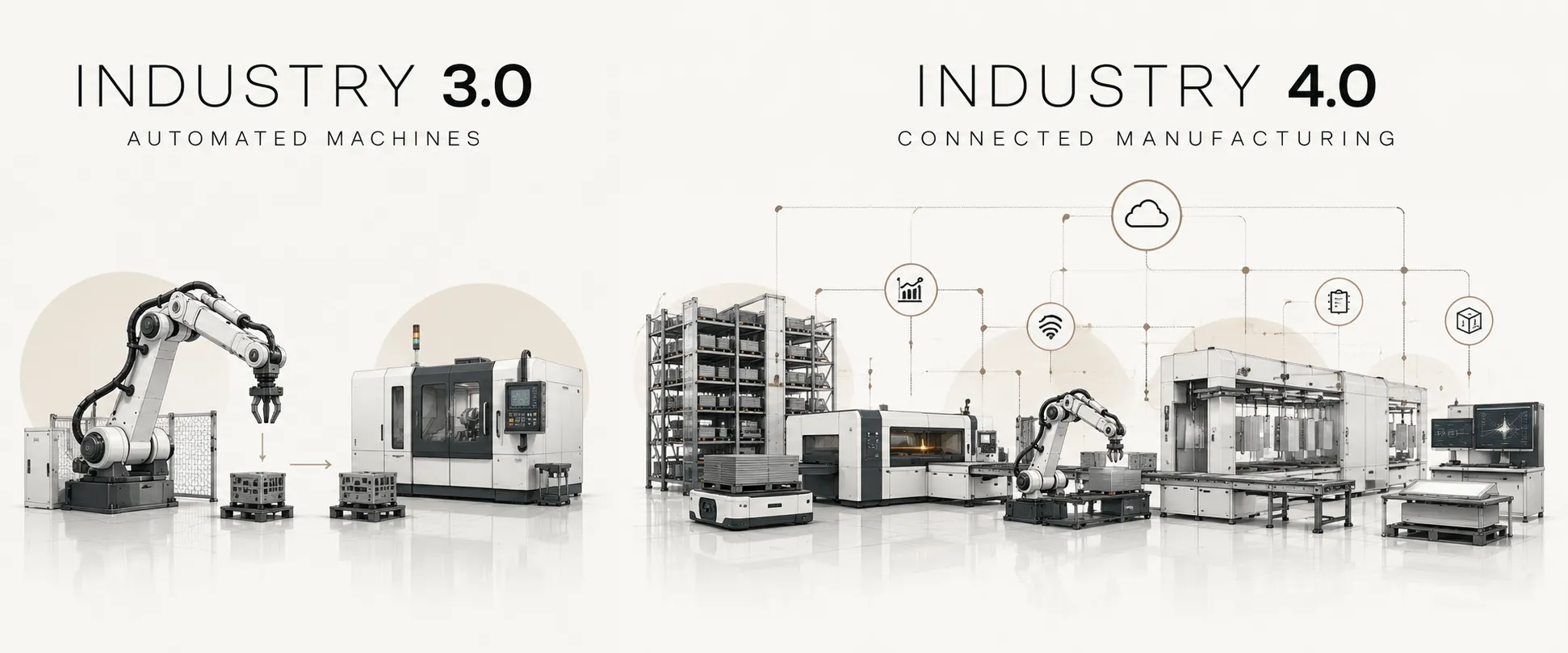
A machine could be exceptionally advanced while remaining relatively isolated from the rest of the factory. It could perform its own task automatically without necessarily understanding what had happened before it, what was coming next or how its operation related to the broader production system.
That distinction is what begins to separate Industry 3.0 from Industry 4.0.
Industry 4.0 — When automation becomes connected
The term Industrie 4.0 emerged in Germany as part of a national strategy around the future of manufacturing. The initiative developed through Germany’s High-Tech Strategy, with Plattform Industrie 4.0 formally launched at Hannover Messe in 2013.
The idea was relatively simple, even if the technology behind it was not: manufacturing systems would no longer operate as disconnected islands.
Machines, sensors, software, products, materials and logistics systems could communicate across a connected production environment.
Industry 3.0 automated the machine. Industry 4.0 connects the factory.
That connection is the real transformation.
What does a smart factory actually look like?
There is no single piece of equipment that makes a factory Industry 4.0.
A robotic arm on its own is automation. A fibre laser on its own is advanced machinery. An automated warehouse on its own is material handling.
Industry 4.0 begins to emerge when those systems are able to exchange information and operate as part of a connected production process.
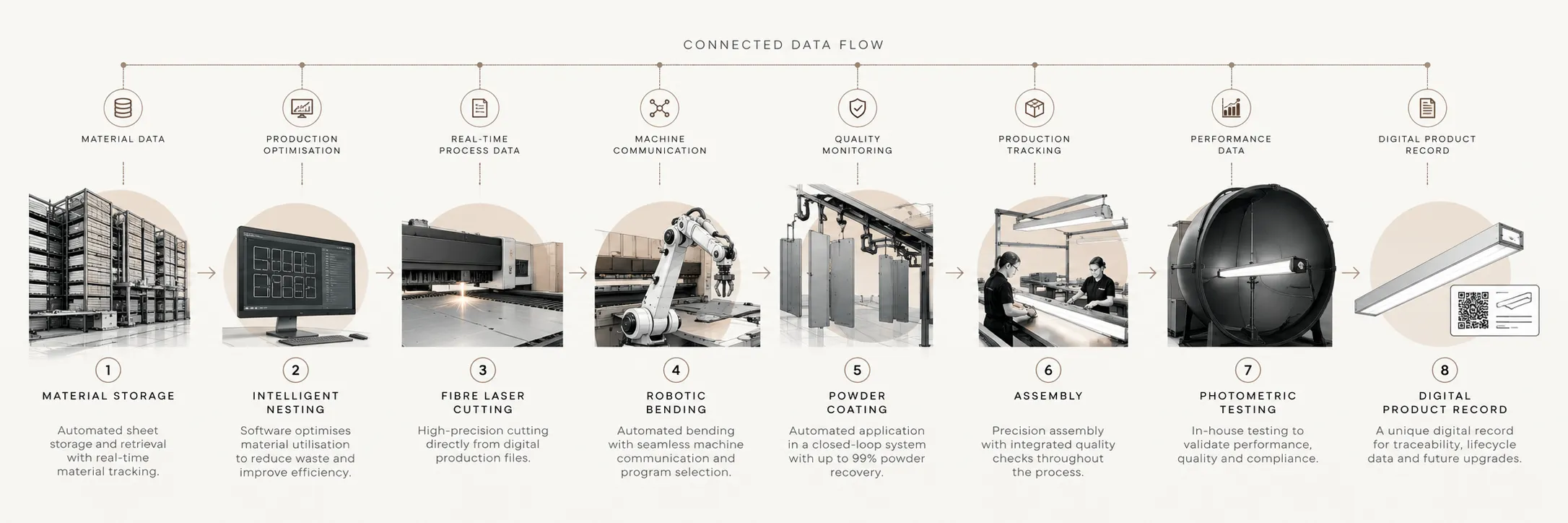
Imagine a sheet metal component moving through an advanced manufacturing facility.
Before cutting begins, a digital production system can identify the material required. Automated storage can locate and retrieve it. Nesting software can determine the most efficient arrangement of components across the sheet, reducing material waste.
The sheet can then move into fibre laser cutting using digital production files. Once cut, those parts can be recognised by downstream equipment. An automated handling or storage system can position them for the next operation. A robotic bending cell can identify the required component, retrieve the correct program and perform the necessary sequence of bends.
The part can then continue through finishing, assembly, testing and dispatch.
No single step defines Industry 4.0. The significance lies in the fact that each step can inform the next.
The technologies behind Industry 4.0
Industry 4.0 has become possible because several technologies have matured at the same time.
Sensors allow machines and processes to generate continuous information. Industrial networks allow that information to move between systems. Artificial intelligence and advanced analytics can identify patterns, optimise production and assist decision-making.
Robotics and autonomous systems reduce repetitive handling and perform increasingly complex operations. Cloud and edge computing allow large volumes of information to be processed and accessed across manufacturing environments. Digital twins can create virtual representations of products, machines or production systems, allowing performance to be modelled before physical changes are made.
The European Parliament identifies sensors, wireless communications, intelligent robots, greater computing power and big-data analytics as key technologies underpinning Industry 4.0. But the technology itself is only part of the story. The real value comes from what those technologies make possible.
Greater control, not simply greater automation
Industry 4.0 is sometimes presented as a race to remove people from manufacturing. That misses much of its value.
The more important advantage is greater visibility and control.
Connected manufacturing can provide a clearer understanding of what is happening across production. How much material is being used? Where is waste being created? Which stage is slowing production? How consistently is a component being produced? When will equipment require maintenance? Can a design be manufactured more efficiently? Can production adapt quickly to a different configuration?
When data becomes available across the process, manufacturers can make better-informed decisions and increasingly automate some of those decisions.
European research identifies increased manufacturing flexibility, mass customisation, greater speed, improved quality and higher productivity among the potential benefits of Industry 4.0.
For a manufacturer, that can fundamentally change the relationship between design and production.
From mass production to mass customisation
The Second Industrial Revolution was largely about producing the same thing efficiently at enormous scale.
Industry 4.0 introduces another possibility: producing variation efficiently.
Digital design, connected production systems and automated machinery make it easier to move between different components, configurations and production requirements.
Rather than requiring an entirely separate production method for every variation, a connected factory can respond to digital information about dimensions, geometry, materials or manufacturing instructions.
This is particularly important in industries where projects rarely conform perfectly to standard products. And lighting is a strong example.
Where Industry 4.0 meets lighting
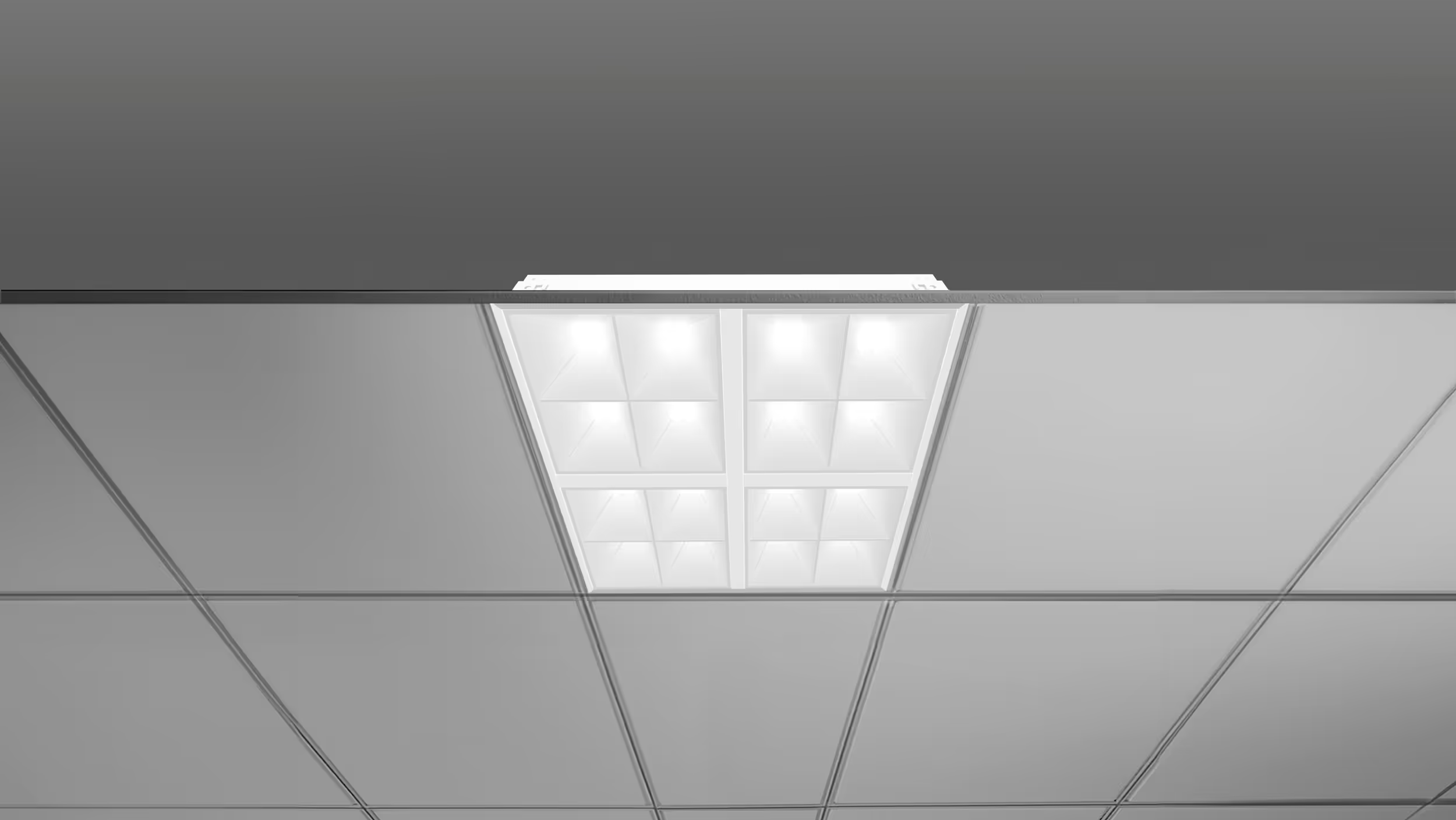
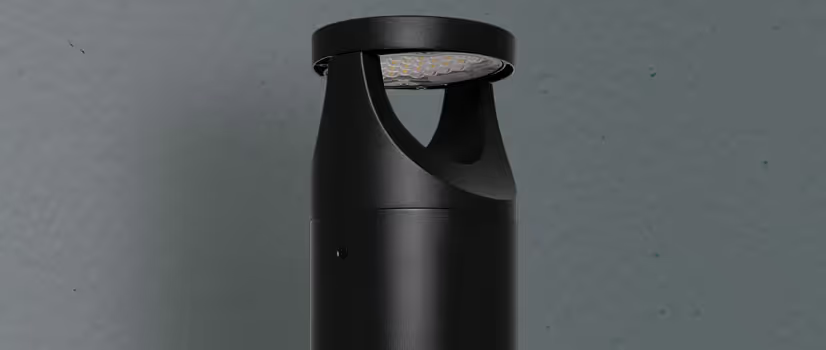
A luminaire may appear relatively simple from the outside, but its performance depends on the interaction of many disciplines: mechanical design, optics, electronics, thermal management, controls, materials, manufacturing tolerances and photometric performance.
A change to one element can influence several others.
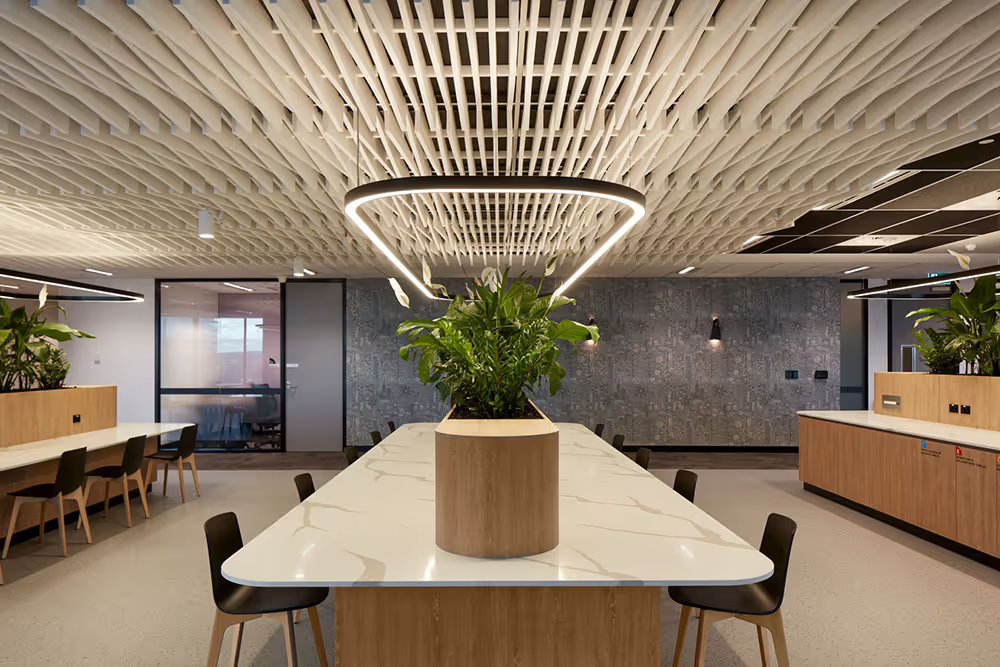
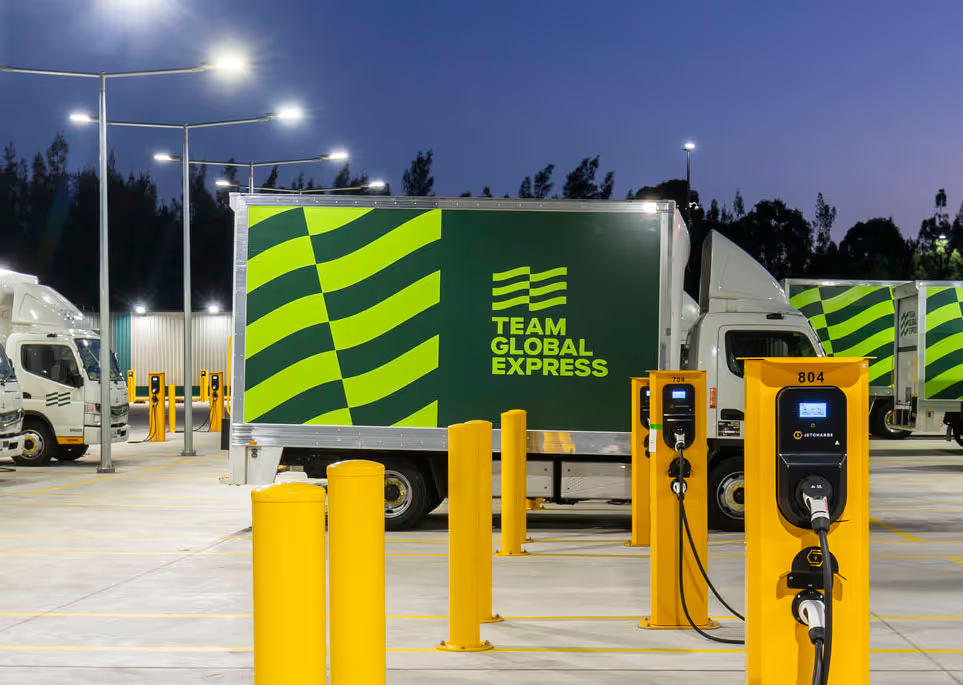
A project may require a different dimension, a specific mounting method, a non-standard finish, different lumen output, a specialised optical distribution, integrated controls, air-handling capability or an entirely bespoke luminaire.
Advanced manufacturing creates greater freedom to respond.
At Novon, that capability is built around connecting design, engineering and manufacturing rather than treating them as separate stages.
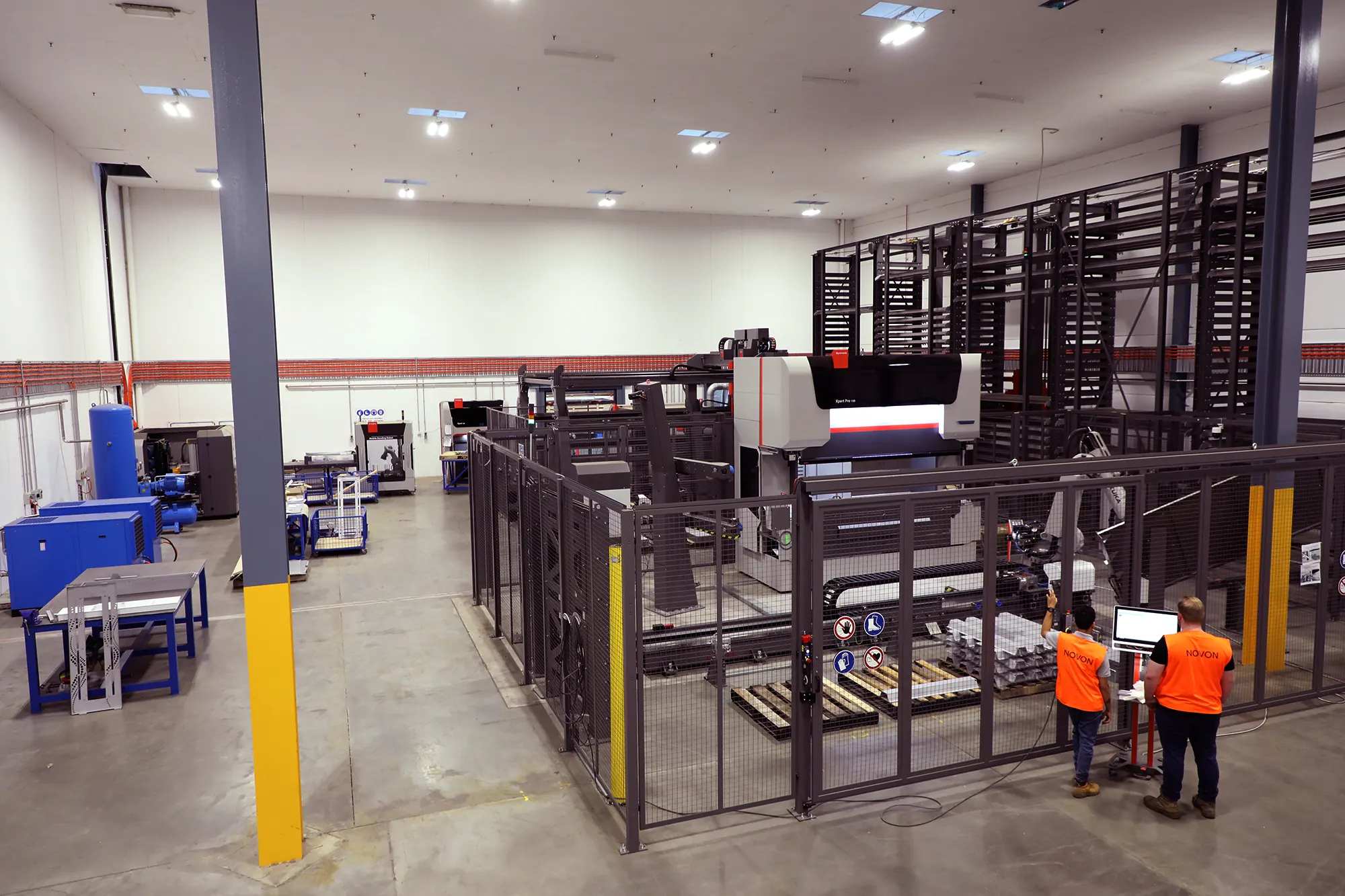
Our automated sheet metal storage system manages 116 material locations and capacity for approximately 330 tonnes of sheet metal. Intelligent nesting software optimises how components are arranged before cutting. A 4kW fibre laser produces components directly from digital manufacturing files.
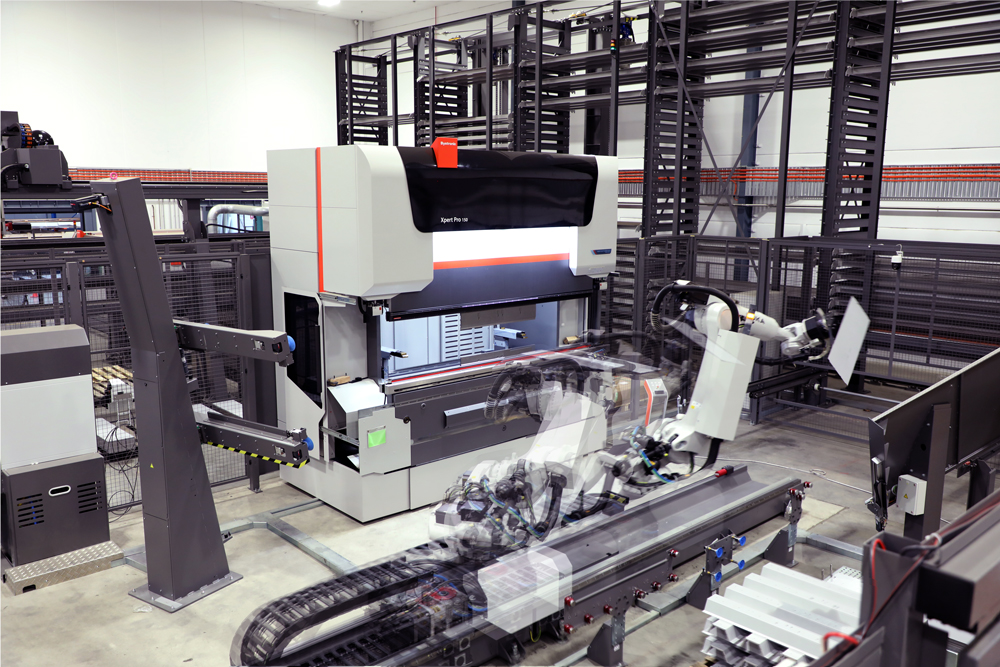
Those components can then move into an autonomous robotic bending environment, where the bending cell communicates with the sheet metal storage and handling system to identify and retrieve the parts required for production.
Robotics position, rotate and form each component through the required sequence before it progresses further through manufacture. Automated powder coating, closed-loop material recovery, assembly and testing continue the process.
The point is not that Novon has a robotic bending cell or an automated laser. The significance lies in how these systems work together.
That is the Industry 4.0 principle in practice.
Discover Novon’s manufacturing
Light engineered beyond the standard
This connected manufacturing capability becomes particularly valuable when projects require something different.
Dimensions can be adapted. Mechanical interfaces can change. Optics, outputs, finishes and controls can be configured around specific requirements. Entirely bespoke luminaires can be developed when an existing product platform cannot provide the right solution.
Advanced manufacturing reduces the distance between engineering intent and physical production.
A design can move from digital modelling through prototyping, manufacturing and testing within one integrated environment.
For Novon, that means customisation is not simply an additional service. It becomes part of the manufacturing capability itself.
Because exceptional projects rarely begin with standard solutions.
Discover Novon’s customised solutions
Smarter manufacturing can also mean less waste
Industry 4.0 is not inherently sustainable. Installing robots does not automatically make a factory environmentally responsible.
But greater visibility and control can create significant opportunities to reduce waste and improve resource efficiency.
Digital nesting can increase material utilisation. Connected systems can reduce unnecessary handling. Automated application processes can improve material consistency. Production data can reveal inefficiencies that may otherwise remain hidden. On-site systems can also remove unnecessary external processes.
At Novon, intelligent nesting is used to maximise sheet utilisation, while manufacturing steel waste is recovered for recycling. Powder coating operates within a closed-loop recovery system, capturing up to 99% of powder particles for filtration and reuse, while process water is captured, filtered and reused.
Nitrogen required for fibre laser cutting is generated and stored on site, reducing reliance on externally delivered gas cylinders. Renewable energy, material optimisation and increasingly circular approaches to product design sit alongside these manufacturing systems.
Discover Novon’s sustainability journey
Greater manufacturing intelligence creates more opportunities to understand impact, identify inefficiency and continually improve.
People still matter
One of the misconceptions surrounding Industry 4.0 is that the smart factory is an entirely autonomous environment with little need for human expertise.
In practice, the role of people changes rather than disappears.
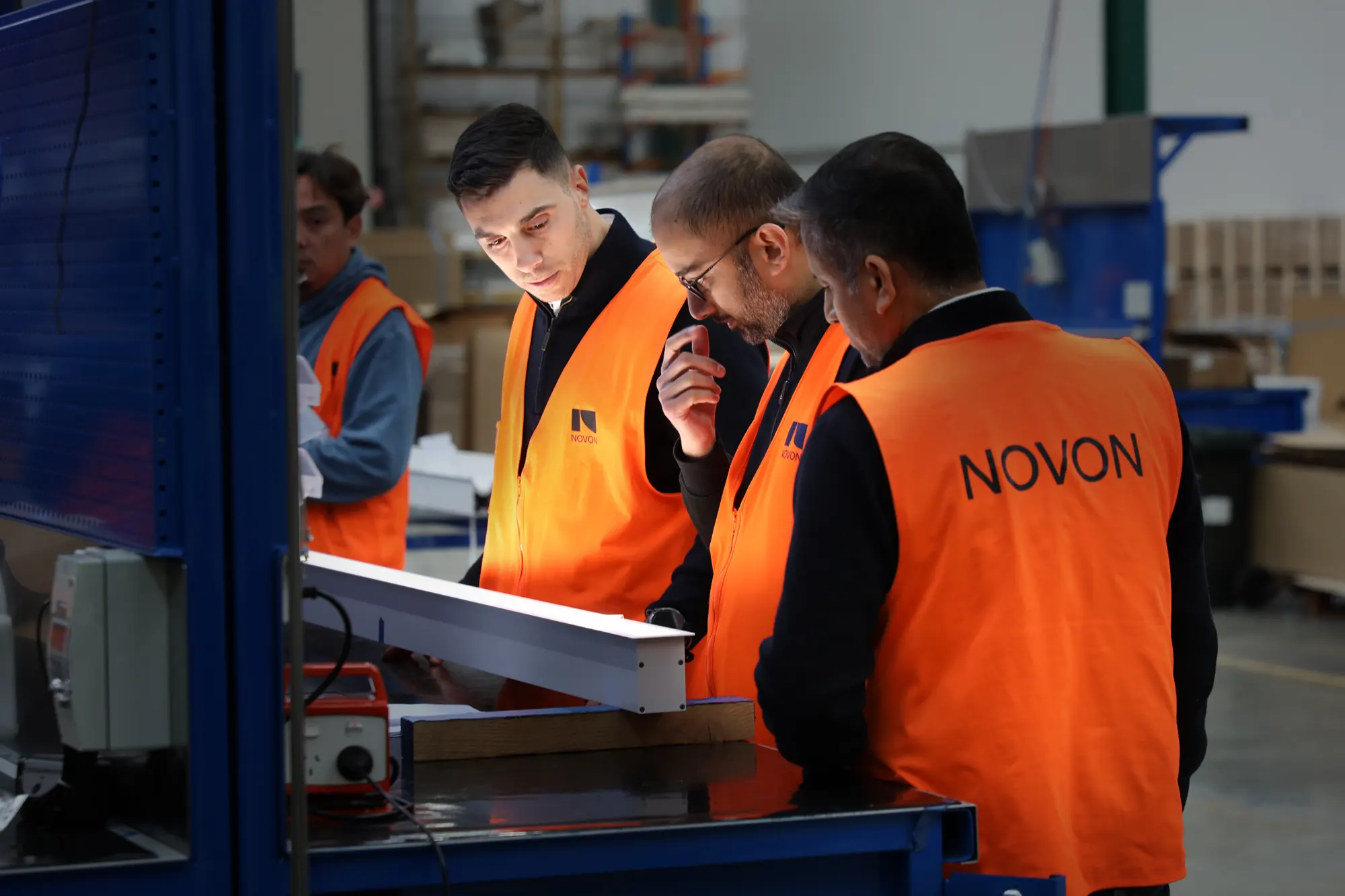
Engineers determine how systems should operate. Product designers establish the intent. Operators supervise sophisticated equipment and production processes. Technicians maintain and optimise machinery. Testing teams validate performance.
Data creates information, but people still need to understand what that information means and how it should influence the product or process.
The Australian Government’s Industry 4.0 initiatives have consequently placed significant emphasis not only on technology adoption, but also on workforce transformation and the skills required to work within increasingly digital manufacturing environments.
The smart factory is therefore not simply a story about machines. It is about the relationship between people, technology and information.
And Industry 4.0 is still evolving
Industry 4.0 is not an endpoint.
Artificial intelligence is already becoming more deeply embedded within industrial systems. Digital twins are becoming more sophisticated. Predictive maintenance is improving. Manufacturing data is increasingly extending beyond the factory and into the operational life of products.
Germany’s Plattform Industrie 4.0 is now explicitly looking toward the next stage of data-driven industry and industrial AI ecosystems.
That evolution will continue. But one of the central ideas behind Industry 4.0 is likely to remain the same.
It is the transition from individual technologies to connected intelligence.
A robot can be impressive. A laser capable of extraordinary precision can be impressive. An autonomous material system can be impressive. But the real transformation occurs when those technologies become part of the same manufacturing conversation.
Advanced manufacturing is ultimately about possibility
Each industrial revolution expanded what manufacturers could do.
Steam enabled mechanisation.
Electricity enabled scale.
Computing enabled automation.
Industry 4.0 enables connection.
Through that connection comes greater visibility, precision, flexibility and control.
For Novon, those capabilities create the freedom to continually improve how lighting is designed, engineered, manufactured and tested, while making project-specific solutions increasingly practical.
Advanced manufacturing is not simply about making more. It is about making better.
Reference sources
AustralianGovernment Department of Industry, Science and Resources: Industry 4.0 Testlabs in Australia report
https://www.industry.gov.au/publications/industry-40-testlabs-australia-report
EuropeanParliament: Industry 4.0: Digitalisation forproductivity and growth
https://www.europarl.europa.eu/thinktank/en/document/EPRS_BRI%282015%29568337
FordMotor Company: Highland Park / Moving Assembly Linehistory
https://corporate.ford.com/articles/history/highland-park.html
PlattformIndustrie 4.0: The History of Plattform Industrie4.0
https://www.plattform-i40.de/IP/Redaktion/EN/Standardartikel/plattform-industrie-history-timeline.html
